Light and Dark Balance Light and Dark Art Balance
The following is a guest blog mail service on fine art composition from Artists Network University instructor Lucy Barber, who has a new online course on drawing and shading (click here to larn more and register!).
Shut your eyes and imagine a moonlit night…
For a time when I lived in Maine I drove back and along from New York, where I would visit family. On i of those trips I was nearing home late on a Lord's day night, driving along an easy stretch of route that was ascension and dipping in the mural. Information technology was dark, the full moon straight ahead in the north about midway upward in the sky. At that place were no streetlights, and although my motorcar headlights were on, only the moon was lighting my way on the road. Because it was late there were no cars in sight backside or in front of me, and none coming from the opposite management. A cute sight, navy dark sky, darker shapes of the trees against the sky, and the landscape that was just a scrap lighter in value than the darkest darks of the trees. The moon of course was the brightest–indirect light from the sun, intense luminosity throwing ambience light onto the landscape.
I wanted to go a sight of this without the motorcar headlights, to see this landscape lighted only past moonlight. So for near 10 seconds I close off the lights and drove by moonlight; the road rising ahead, a ribbon of eye-value low-cal possessing a luminosity all its own. With airtight optics I now run into the image as though it was yesterday!
That scene in front end of me was predominantly on the darker end of a black and white value scale, with the lightest calorie-free being the moon and some reflections of its low-cal on the roadway. All the remaining values are in close human relationship to each other, creating a potent cohesiveness to the "composition" equally well as an illusion of a dark ambience calorie-free in a moonlit landscape.
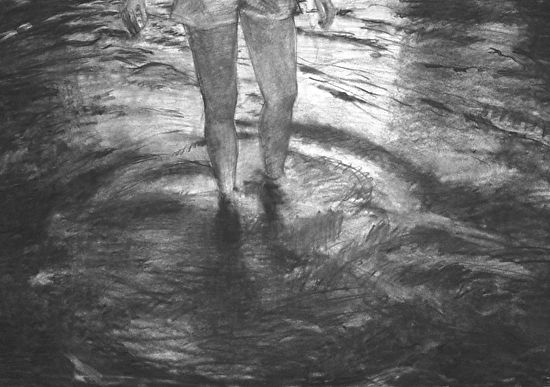
I'thou thinking about this because it's the light and dark values in relationship to each other and the simplified massing of values that play such an important role in a composition's design. In improver, those light and dark value relationships impact the quality of light and "luminosity" in a work, as well every bit strengthening an illusion of infinite, atmosphere and volume in the forms.
Create an Effective Art Composition
In club to create an constructive composition, it'southward of import to minimize breaking up value masses. If your composition is express to four or five values, the simplified value masses concord the pattern together similar an elegant puzzle, with all value shapes playing a office. This is also important when cartoon a unproblematic course, such every bit a sphere. You offset want to run into the simplified value shapes: the lighted side of the sphere, the shaded side of the sphere, and the bandage shadow. At the first, you tin depict the shaded side of the sphere and the cast shadow equally 1 big shape, and then work selectively on subtle gradations from the lighted side to the shaded side and bandage shadow. This volition help maintain the illusion of volume, class and lite. Too much breaking up of the value masses with jumpy transitions in the sphere and bandage shadow will actually flatten the course.
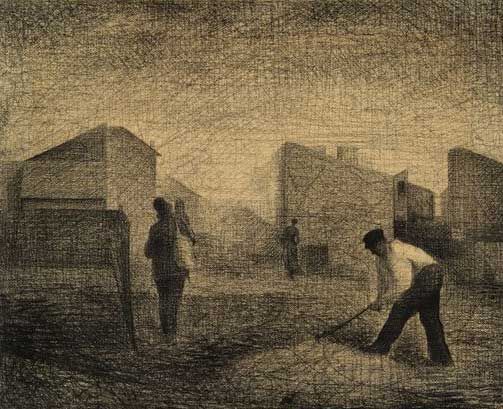
If you look at two examples of Georges Seurat'due south drawings here y'all see a mural on the left and on the right a portrait of a woman intensely focusing on her activeness. In the mural I meet five values. If y'all look at the lighter areas of the buildings and how that aforementioned value carries through to other places in the composition–to the lighted areas of the ground plane where the man is raking and in the middle footing right beneath the buildings–you can see how those aforementioned values unify the lower two-thirds of the composition. As well, the darkest shapes and their placement, once more in the lower two-thirds of the composition, work in tandem with the lighter shapes to create a beautiful unity. The values in the sky gradate upwards from low-cal to darker, a reflection of the values in the lower part of the limerick. Await at how elegantly Seurat has created a sense of volume, infinite and light with simplified value shapes!

In the portrait above I see four, possibly five values. The lightest surface area is very small, much like the moonlit landscape I describe above. The next darker areas, the light on her olfactory organ, forehead, and top of her caput, besides take upwardly a small area proportionally to the whole limerick. This creates a clear area of strong calorie-free and dark contrast, drawing our eyes to the primal subject field, an intimate composition of a woman intent on an activity. This is a beautiful example of unified value masses, letting some edges disappear every bit we move from ane shape to the next, drawing our eye to a articulate area of focus.
Register for Lucy'south class, Drawing Mastery: Shading, today!
Source: https://www.artistsnetwork.com/art-techniques/composition/art-composition-the-expression-of-light-and-dark-values/
0 Response to "Light and Dark Balance Light and Dark Art Balance"
Post a Comment